
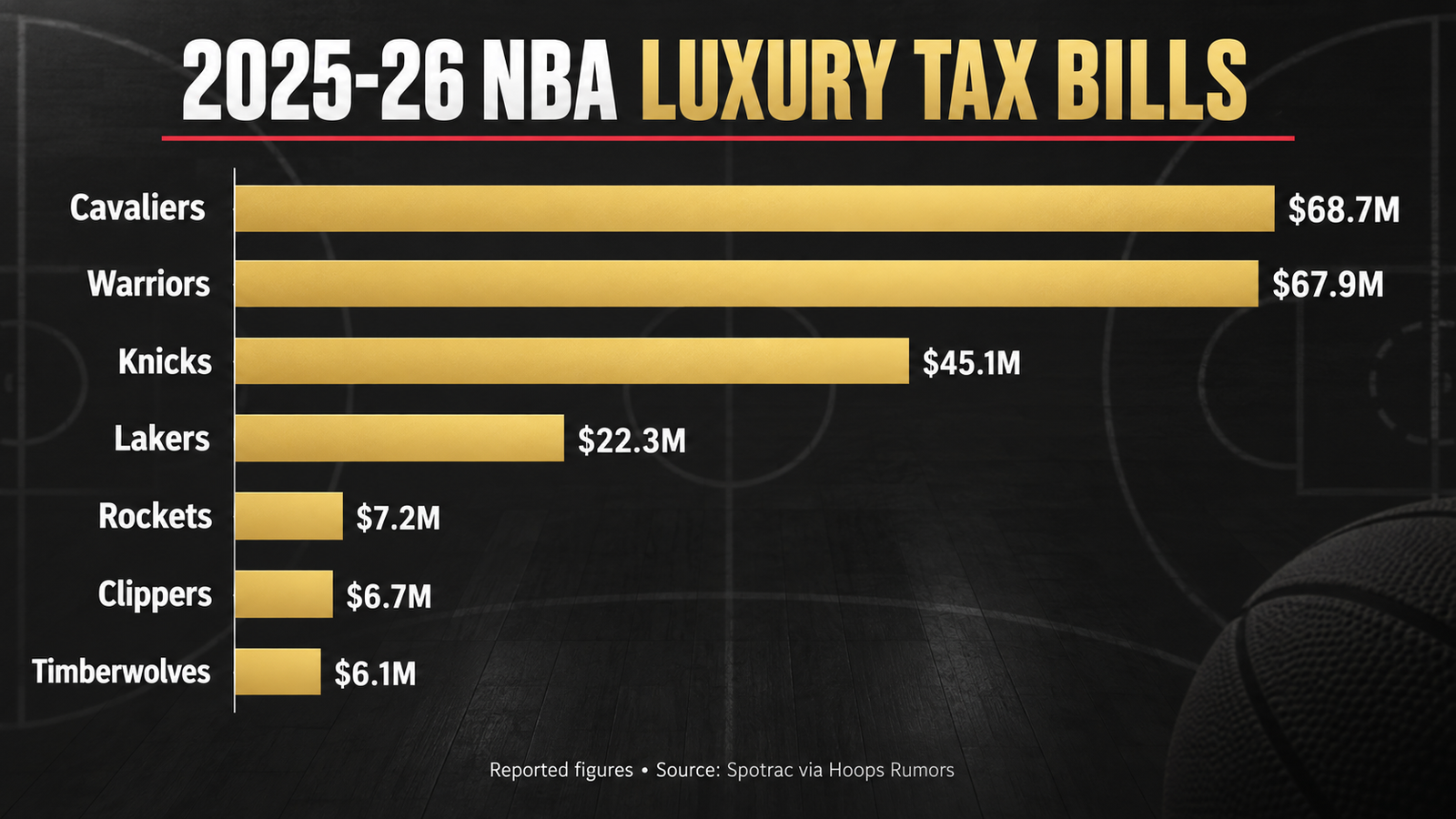
The NBA luxury tax bills 2025-26 are now set. Seven teams finished the season on the wrong side of the tax line, and two of them, the Cleveland Cavaliers and Golden State Warriors, each owed the league nearly $70 million for the privilege. Combined, the seven taxpaying franchises are on the hook for roughly $223.1 million in penalties, according to Hoops Rumors’ April 16, 2026 reporting, which sources its figures to Spotrac’s NBA tax tracker and was independently corroborated by a matching Yahoo Sports and Yardbarker report the same week.
For a league that just raised its 2027-28 salary cap projection to $176 million and already runs a $222 million second apron for 2026-27, these are the real dollars teams are paying right now for the rosters they built. Here is the full breakdown.
The Full 2025-26 Luxury Tax Bill, Team by Team
| Team | 2025-26 Luxury Tax Bill | Repeater Status |
|---|---|---|
| Cleveland Cavaliers | $68,671,517 | No |
| Golden State Warriors | $67,909,145 | Yes |
| New York Knicks | $45,063,450 | No |
| Los Angeles Lakers | $22,266,323 | Yes |
| Houston Rockets | $7,174,303 | No |
| LA Clippers | $6,665,742 | Yes |
| Minnesota Timberwolves | $6,137,583 | No |
Source: Spotrac’s NBA tax tracker, reported by Hoops Rumors, April 16, 2026.
Cleveland and Golden State alone account for roughly $136.6 million of the $223.1 million total, more than three of every five dollars the league will collect from this year’s taxpayers. The Knicks are a distant third at just over $45 million, and the gap widens fast from there: the bottom four teams on the list combined owe less than the Warriors do by themselves.
How a $95 Million Trade-Deadline Swing Cut the Taxpayer List From 14 to 7
The seven-team final list is not where the season started. Hoops Rumors’ own reporting shows 14 teams were on pace to pay the tax before the 2026 trade deadline, a number that dropped by half once deadline-week deals kicked in. Cleveland’s swing was the single biggest: the Cavaliers cut their own projected bill by more than $95 million through trades, even though they still ended up as the league’s largest taxpayer at nearly $69 million.
That is the practical lesson buried in the trade-deadline chaos every February: shedding salary before the deadline is not just about improving a roster on the floor, it is often the only lever a front office has left to control what the team owes the league months later. A team that looks like a tax outlier in January can look completely different by the time the season actually closes the books.
Repeater Tax, Explained: Why Golden State, the Lakers and the Clippers Pay More Per Dollar
Three of the seven 2025-26 taxpayers, Golden State, the Lakers and the Clippers, were flagged by Spotrac’s tracker as repeater-tax payers, per Hoops Rumors’ reporting. Under the CBA, a team that has paid the luxury tax in at least three of the previous four seasons gets hit with a steeper, escalating tax rate on every dollar above the threshold than a first-time or occasional taxpayer does. That is a meaningful part of why Golden State’s bill runs almost as high as Cleveland’s: the Warriors are not just spending a lot, they are spending a lot while already inside the CBA’s penalty box for having done it repeatedly.
It also helps explain why the Lakers’ bill, at roughly $22.3 million, sits well behind the top three even though the team has been a frequent tax payer in recent seasons; a smaller amount of money above the line still gets taxed at that same repeater rate, but the total bill scales with how far over the threshold a roster actually sits, not just whether the repeater label applies.
Where the Money Goes: The Distribution to 23 Other Teams
The $223.1 million collected from this year’s seven taxpayers does not disappear into the league office. It gets redistributed to the 23 teams that stayed under the tax line, which were on pace to split roughly $4.9 million apiece, according to Hoops Rumors’ reporting of figures attributed to ESPN’s Bobby Marks. That per-team number is down sharply from the $11.53 million each non-taxpaying team received in 2024-25, and well below an earlier, pre-deadline projection of $13.8 million per team, a drop Marks attributed to the wave of deadline trades that pushed teams below the tax line and shrank the total pool available to distribute.
That swing matters for how teams plan their own books. A front office building a budget around an expected multimillion-dollar tax-distribution check has real incentive to watch what rival taxpayers do at the deadline, since one team’s decision to duck under the line by trading away salary directly shrinks the payout every other under-the-cap team was counting on.
How 2025-26’s Bills Compare to Where the Cap Is Headed
These bills were calculated against 2025-26’s cap structure, one season before the tighter, more restrictive rules NBA Trending has covered in its breakdown of the NBA’s second apron took full effect for 2026-27, where the cap sits at $165 million, the tax line at $201 million, and the second apron at $222 million. The league has since raised its 2027-28 salary cap projection to $176 million, with a projected 2027-28 tax line of $213 million, according to Fred Katz of The Athletic. Every one of those numbers moves the tax line further from where it sat when Cleveland and Golden State built the rosters that produced this year’s bills, which means a repeat performance next season would require spending even more, in raw dollars, just to land in the same relative position above the threshold.
What This Data Tells Contenders Building a 2026-27 Roster
The clearest signal in this year’s numbers is not the size of any single bill, it is how concentrated the pain actually was. Two teams paid three-fifths of the league’s entire tax bill, seven teams shed enough salary by the deadline to drop off the taxpayer list entirely, and the gap between the top of the list and the bottom of it is wider than the bottom four teams’ bills combined. For a front office weighing whether to keep an expensive roster intact through a full season or trade pieces away to duck under the line, 2025-26 is the clearest recent data point yet: the tax bill for staying the course, if a team is Cleveland or Golden State’s kind of team, now runs close to $70 million, and the CBA’s repeater math only makes staying there more expensive the longer a front office keeps doing it.