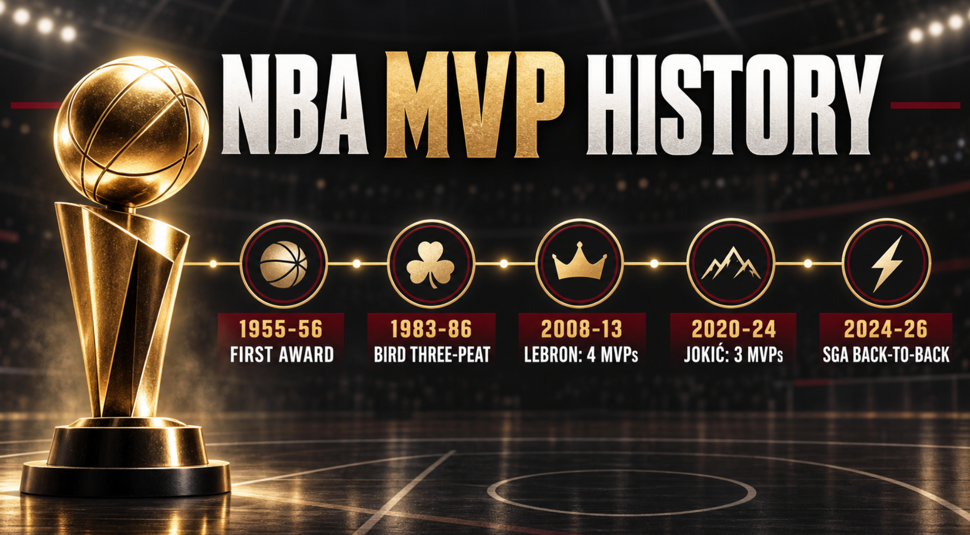
The NBA Most Valuable Player award has tracked the league’s changing definition of greatness since Bob Pettit won the inaugural honor in 1955-56. It has rewarded dominant centers, transformational guards, statistical outliers and the central figures on championship contenders. It has also produced debates that outlive the seasons in which the votes were cast.
Shai Gilgeous-Alexander is the latest player to add a new chapter. The Oklahoma City Thunder guard won the 2025-26 Michael Jordan Trophy, repeating as MVP after his 2024-25 victory. He became the 14th player to win consecutive MVP awards, joining one of the award’s most exclusive groups.
This guide contains every regular-season MVP winner, explains how voting has evolved and examines the records, eras and patterns behind more than seven decades of results.
NBA MVP winners by year
| Season | Winner | Team |
|---|---|---|
| 2025-26 | Shai Gilgeous-Alexander | Oklahoma City Thunder |
| 2024-25 | Shai Gilgeous-Alexander | Oklahoma City Thunder |
| 2023-24 | Nikola Jokic | Denver Nuggets |
| 2022-23 | Joel Embiid | Philadelphia 76ers |
| 2021-22 | Nikola Jokic | Denver Nuggets |
| 2020-21 | Nikola Jokic | Denver Nuggets |
| 2019-20 | Giannis Antetokounmpo | Milwaukee Bucks |
| 2018-19 | Giannis Antetokounmpo | Milwaukee Bucks |
| 2017-18 | James Harden | Houston Rockets |
| 2016-17 | Russell Westbrook | Oklahoma City Thunder |
| 2015-16 | Stephen Curry | Golden State Warriors |
| 2014-15 | Stephen Curry | Golden State Warriors |
| 2013-14 | Kevin Durant | Oklahoma City Thunder |
| 2012-13 | LeBron James | Miami Heat |
| 2011-12 | LeBron James | Miami Heat |
| 2010-11 | Derrick Rose | Chicago Bulls |
| 2009-10 | LeBron James | Cleveland Cavaliers |
| 2008-09 | LeBron James | Cleveland Cavaliers |
| 2007-08 | Kobe Bryant | Los Angeles Lakers |
| 2006-07 | Dirk Nowitzki | Dallas Mavericks |
| 2005-06 | Steve Nash | Phoenix Suns |
| 2004-05 | Steve Nash | Phoenix Suns |
| 2003-04 | Kevin Garnett | Minnesota Timberwolves |
| 2002-03 | Tim Duncan | San Antonio Spurs |
| 2001-02 | Tim Duncan | San Antonio Spurs |
| 2000-01 | Allen Iverson | Philadelphia 76ers |
| 1999-00 | Shaquille O’Neal | Los Angeles Lakers |
| 1998-99 | Karl Malone | Utah Jazz |
| 1997-98 | Michael Jordan | Chicago Bulls |
| 1996-97 | Karl Malone | Utah Jazz |
| 1995-96 | Michael Jordan | Chicago Bulls |
| 1994-95 | David Robinson | San Antonio Spurs |
| 1993-94 | Hakeem Olajuwon | Houston Rockets |
| 1992-93 | Charles Barkley | Phoenix Suns |
| 1991-92 | Michael Jordan | Chicago Bulls |
| 1990-91 | Michael Jordan | Chicago Bulls |
| 1989-90 | Magic Johnson | Los Angeles Lakers |
| 1988-89 | Magic Johnson | Los Angeles Lakers |
| 1987-88 | Michael Jordan | Chicago Bulls |
| 1986-87 | Magic Johnson | Los Angeles Lakers |
| 1985-86 | Larry Bird | Boston Celtics |
| 1984-85 | Larry Bird | Boston Celtics |
| 1983-84 | Larry Bird | Boston Celtics |
| 1982-83 | Moses Malone | Philadelphia 76ers |
| 1981-82 | Moses Malone | Houston Rockets |
| 1980-81 | Julius Erving | Philadelphia 76ers |
| 1979-80 | Kareem Abdul-Jabbar | Los Angeles Lakers |
| 1978-79 | Moses Malone | Houston Rockets |
| 1977-78 | Bill Walton | Portland Trail Blazers |
| 1976-77 | Kareem Abdul-Jabbar | Los Angeles Lakers |
| 1975-76 | Kareem Abdul-Jabbar | Los Angeles Lakers |
| 1974-75 | Bob McAdoo | Buffalo Braves |
| 1973-74 | Kareem Abdul-Jabbar | Milwaukee Bucks |
| 1972-73 | Dave Cowens | Boston Celtics |
| 1971-72 | Kareem Abdul-Jabbar | Milwaukee Bucks |
| 1970-71 | Kareem Abdul-Jabbar | Milwaukee Bucks |
| 1969-70 | Willis Reed | New York Knicks |
| 1968-69 | Wes Unseld | Baltimore Bullets |
| 1967-68 | Wilt Chamberlain | Philadelphia 76ers |
| 1966-67 | Wilt Chamberlain | Philadelphia 76ers |
| 1965-66 | Wilt Chamberlain | Philadelphia 76ers |
| 1964-65 | Bill Russell | Boston Celtics |
| 1963-64 | Oscar Robertson | Cincinnati Royals |
| 1962-63 | Bill Russell | Boston Celtics |
| 1961-62 | Bill Russell | Boston Celtics |
| 1960-61 | Bill Russell | Boston Celtics |
| 1959-60 | Wilt Chamberlain | Philadelphia Warriors |
| 1958-59 | Bob Pettit | St. Louis Hawks |
| 1957-58 | Bill Russell | Boston Celtics |
| 1956-57 | Bob Cousy | Boston Celtics |
| 1955-56 | Bob Pettit | St. Louis Hawks |
Source: NBA.com’s official year-by-year MVP history, updated after the 2025-26 award.
Who has won the most NBA MVP awards?
Kareem Abdul-Jabbar holds the record with six MVP awards. Michael Jordan and Bill Russell follow with five each, while Wilt Chamberlain and LeBron James have four apiece. That leaderboard captures several distinct versions of dominance. Abdul-Jabbar’s awards span Milwaukee and Los Angeles; Russell’s reflect the league’s most successful dynasty; Jordan’s track the Bulls’ rise into a global phenomenon; and James won with two franchises across four seasons.
The award is difficult to monopolize because voters assess one regular season at a time. Injuries, team record, changing roles, voter fatigue and the emergence of another extraordinary candidate can interrupt even a historically dominant run. Nikola Jokic, for example, won three times in four seasons, but Joel Embiid’s 2022-23 victory prevented a three-peat.
The rarest MVP achievement: three consecutive wins
Only three players have won at least three consecutive MVP awards. Bill Russell won three straight from 1960-61 through 1962-63. Wilt Chamberlain followed with three from 1965-66 through 1967-68. Larry Bird became the most recent, winning in 1983-84, 1984-85 and 1985-86.
That is the historical challenge facing Gilgeous-Alexander in 2026-27. Consecutive victories already place him in elite company; a third would connect his run to a feat that has not occurred in more than four decades.
Stephen Curry and the first unanimous MVP
Stephen Curry’s 2015-16 season remains a voting landmark. He received all 131 first-place votes after leading Golden State to a 73-9 record, becoming the first unanimous MVP in league history. His combination of volume, efficiency and unprecedented three-point shooting changed both the award race and the geometry of NBA offense.
Unanimity is not simply shorthand for an excellent season. It means every voter agreed that no alternative candidate deserved first place. Many all-time seasons did not reach that standard, which is why Curry’s result remains distinctive.
How the MVP electorate changed
The award was originally selected by NBA players. Beginning with the 1980-81 season, voting shifted to a panel of sportswriters and broadcasters. The modern process uses ranked ballots and weighted points, making first-place support especially valuable while still recognizing candidates placed second through fifth.
That distinction matters when reading a final points total. An MVP can win through overwhelming first-place support, while a close race may reveal disagreement about whether value means individual production, team success, availability, two-way impact or some combination of all four.
The trophy itself was renamed the Michael Jordan Trophy in 2022. The name connects the modern award to a five-time winner, but the historical record still begins in 1955-56.
From the age of centers to the age of creators
The early MVP record is dominated by big men. Russell, Chamberlain, Abdul-Jabbar, Pettit and Cowens collectively controlled much of the award’s first two decades. Their value reflected the structure of the game: rim protection, rebounding and interior scoring shaped almost every possession.
The 1980s widened the template. Bird and Magic Johnson won six of seven awards between 1983-84 and 1989-90, demonstrating that elite playmaking and control of an entire offense could define value as strongly as traditional interior dominance.
Jordan then established the two-way scoring wing as an MVP archetype. The following decades produced more variety: power forwards such as Karl Malone, Kevin Garnett and Tim Duncan; scoring guards such as Allen Iverson, Kobe Bryant, Curry, Russell Westbrook and James Harden; and jumbo creators such as LeBron and Jokic.
The international era
The MVP has become one of the clearest measures of basketball’s globalization. From 2018-19 through 2025-26, every winner was born outside the United States: Giannis Antetokounmpo, Jokic, Embiid and Canadian guard Gilgeous-Alexander.
This is more than a run of unrelated winners. It reflects international development systems producing players who arrive with advanced professional experience, while the NBA’s spacing and skill demands increasingly reward versatile decision-makers. Jokic’s passing, Antetokounmpo’s transition force, Embiid’s interior scoring and SGA’s control of pace are different styles, but each stretches older positional definitions.
Does the MVP have to come from the best team?
No formal rule requires the winner to play for the league’s best team. Team performance nevertheless remains a powerful part of the argument because winning supplies evidence that a candidate’s production changes meaningful outcomes.
There are exceptions. Kareem won in 1975-76 even though the Lakers missed the playoffs, an outcome that would be extraordinarily difficult under modern voting expectations. Westbrook’s 2016-17 victory came with Oklahoma City seeded sixth in the Western Conference, driven by his historic triple-double season and late-game impact.
These cases demonstrate why the word “valuable” never produces a single permanent formula. Voters generally favor elite players on excellent teams, but a sufficiently unusual individual season can move the boundary.
MVP does not mean Finals MVP
The regular-season MVP and NBA Finals MVP are separate awards. Regular-season MVP voting evaluates performance before the playoffs. Finals MVP recognizes performance in the championship series. A player can win one without the other, and the team that employs the regular-season MVP does not necessarily reach the Finals.
That separation is essential when comparing legacies. The MVP measures season-long regular-season influence; championships and Finals MVPs measure a different environment with smaller samples, specific matchups and elimination pressure.
What SGA’s repeat says about the modern race
Gilgeous-Alexander’s second award confirms that his first was not treated as a one-season breakthrough. His case combined scoring efficiency, clutch production and the Thunder’s sustained regular-season success. The official 2025-26 vote placed him ahead of Jokic and Victor Wembanyama, two candidates whose styles represent very different definitions of value.
That competition is what makes the next race compelling. SGA is pursuing the first three-peat since Bird. Jokic remains capable of controlling games through scoring, rebounding and passing. Wembanyama’s two-way ceiling creates a route built around both offensive creation and defensive deterrence. The award’s history suggests that incumbency alone will not decide it; health, team results and the clarity of each player’s season-long case will.
Frequently asked questions
Who won the first NBA MVP award?
Bob Pettit of the St. Louis Hawks won the inaugural award for the 1955-56 season.
Who has the most NBA MVP awards?
Kareem Abdul-Jabbar holds the record with six.
Has anyone won three MVP awards in a row?
Yes. Bill Russell, Wilt Chamberlain and Larry Bird each won at least three consecutive MVP awards. Bird was the most recent, completing his run in 1985-86.
Who was the first unanimous NBA MVP?
Stephen Curry became the first unanimous winner in 2015-16, receiving every first-place vote.
Who won the 2025-26 NBA MVP?
Shai Gilgeous-Alexander won his second consecutive MVP for the Oklahoma City Thunder.
Is the MVP based on the playoffs?
No. The Michael Jordan Trophy recognizes regular-season performance. Playoff results are not part of the voting period.