
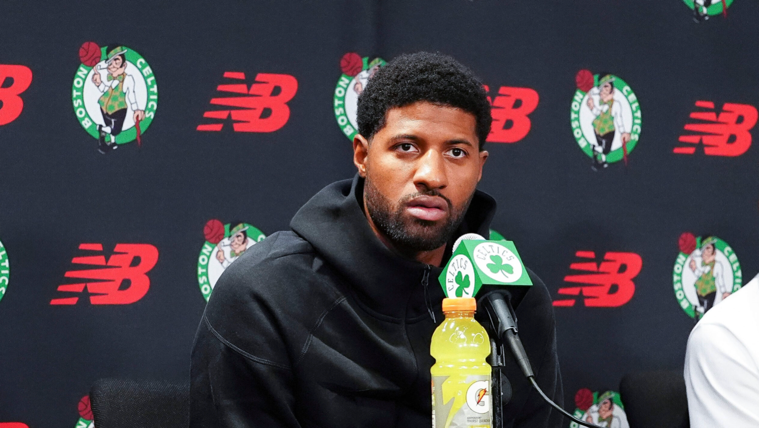
Boston’s entire offseason case rests on a single variable nobody can fully control. ESPN’s Vincent Goodwill projected the Celtics at 48-34 and fifth in the Eastern Conference for 2026-27, a notably modest forecast for a franchise that has posted 50 or more wins in five of the last six seasons. His reasoning, laid out on Aug. 25, comes down to one name: “Boston is banking on a full season from Jayson Tatum,” Goodwill wrote, “and hoping Paul George can stay upright and healthy.” A sub-50-win season would be the Celtics’ first since 2020-21, when they went 36-36. That is the gap between where this roster has lived recently and where the league’s own projections now put it.
Why the Bar Dropped This Low
The projection isn’t a mystery once last season is accounted for. Tatum tore his Achilles and played only 16 games in 2025-26, then missed Boston’s own Game 7 playoff loss to Philadelphia in May with left knee stiffness, a separate issue from the Achilles that nonetheless kept him out for the biggest game of the season. That Boston still finished 56-26 and reached a Game 7 without its best player playing more than a fifth of the schedule is itself the case for why expectations should, in theory, rise once he’s back. Jaylen Brown carried the load in Tatum’s absence, averaging 28.7 points, 6.9 rebounds and 5.1 assists and finishing sixth in MVP voting, production that kept the Celtics competitive but wasn’t enough to get past Philadelphia.
The Trade That Changed Everything
Boston didn’t run it back with that same group. On July 6, the Celtics finalized a trade sending Brown to the 76ers for Paul George, a nine-time All-Star, along with an unprotected 2031 first-round pick, a conditional 2028 first-round pick and two conditional second-round picks, according to Hoops Rumors’ reporting on the deal. Celtics president of basketball operations Brad Stevens framed the move as a difficult but clean break from a player who had been with the organization a decade: “He is a terrific player and has also had a huge impact off the court,” Stevens said. “On a personal level, I am thankful to have had a front row seat to the first 10 years of his illustrious career.” Boston also added center Mitchell Robinson in free agency, giving the frontcourt a rim-protecting piece it didn’t previously have.
What the George-for-Brown Swap Actually Means
The trade is a bet on fit over redundancy. Brown and Tatum had spent years sharing wing minutes and shot attempts, a pairing that produced a championship but also periodic questions about who the offense should run through in crunch time. George, at 36, is a different kind of complement: a three-level scorer who can play off Tatum as a secondary option rather than compete with him for the same role Brown occupied. That logic only works if George’s body cooperates, which is exactly Goodwill’s stated concern, and it only matters at all if Tatum is healthy enough to be the offense’s primary engine for 82 games rather than 16.
That is the swing factor no roster move can hedge against. A healthy Tatum playing next to a genuinely complementary scorer in George, with Robinson anchoring the paint, is a real path back toward the top of the conference. An injury setback to either Tatum or George, the exact scenario Goodwill flagged by name, would leave Boston relying on a supporting cast that already showed its ceiling last season: competitive enough for 56 wins and a trip to Game 7, not enough to get past a good team without its best player.
What Training Camp Actually Has to Answer
None of this gets settled by a trade grade or a preseason projection. Boston has to find out in real games whether Tatum looks like himself physically after the Achilles recovery, whether George’s 36-year-old body holds up over an 82-game slate, the exact durability question Goodwill raised by name, and whether the George-Tatum pairing generates the kind of half-court offense Brown and Tatum sometimes struggled to unlock together. Camp opens over the next several weeks across the league, the exact window where those answers start to take real shape before games count. For the full run-up to opening night league-wide, see NBA Trending’s guide to the 2026-27 season’s key dates ().
Boston spent last season proving it could stay competitive without its best player. This season is built entirely around not having to prove that again.