
Updated Nov. 19, 2026.
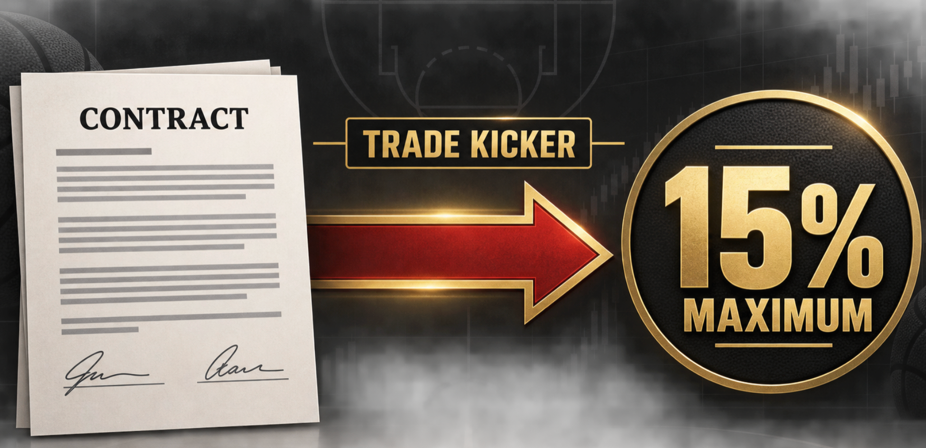
An NBA trade kicker is a negotiated contract clause that pays a player a bonus when his contract is traded. The Collective Bargaining Agreement calls it a trade bonus. It can reward a player for losing control over where he plays, but it can also change the salary-cap math that determines whether a proposed trade is legal.
The headline number is 15%, but that does not mean every player receives 15% of his entire contract. The percentage applies to eligible base compensation still remaining at the time of the first trade, subject to other limits in the CBA.
NBA Trade Kicker Rules at a Glance
| Rule | What it means |
|---|---|
| Maximum size | Up to 15% of remaining eligible base compensation |
| Who pays | The team trading the player |
| When it triggers | The first time that contract is traded |
| Option years | An unexercised option year is excluded |
| Receiving-team cap treatment | The bonus increases the player’s cap salary under the applicable allocation rules |
| Can it be waived? | Yes, the player may waive all or part when permitted to help complete a trade |
How the 15% Maximum Is Calculated
The CBA limits a trade bonus to 15% of the base compensation that remains to be earned under the contract when the trade occurs. An option season that has not been exercised does not count in that calculation. The contract can specify a smaller percentage or no trade bonus at all.
The basic calculation is:
Eligible remaining base compensation × negotiated trade-bonus percentage = potential bonus
Suppose a player is traded before a season and has two fully guaranteed years remaining at $20 million per year. His eligible remaining base compensation is $40 million. A maximum 15% kicker would produce a potential $6 million bonus.
| Example item | Amount |
|---|---|
| Guaranteed salary remaining | $40 million |
| Negotiated trade kicker | 15% |
| Potential cash bonus | $6 million |
| Trading team pays | $6 million |
| Illustrative equal allocation | $3 million added to each remaining season |
That example assumes equal guaranteed salaries and a trade before the season. A midseason trade requires a more detailed calculation because only the compensation still to be earned is eligible, and the current season is handled using the league’s timing and allocation rules.
Who Pays the Trade Kicker?
The team sending the player pays the bonus in cash. The acquiring team does not write the bonus check, but the player’s adjusted salary can count on its books for salary-cap and trade purposes.
This distinction is why a trade kicker can affect both sides differently. The outgoing team bears the cash cost. The incoming team must fit the adjusted cap number into the transaction and its post-trade payroll. For teams close to a hard cap or an apron, even a relatively small adjustment can matter.
How the Bonus Affects Salary-Cap Math
A trade bonus is generally allocated across the remaining guaranteed seasons of the contract. That allocation raises the player’s cap salary for the receiving team, even though the trading team pays the cash.
The adjusted number can influence three separate questions:
- Whether the teams satisfy the NBA’s salary-matching rules.
- Whether the acquiring team remains below a hard cap or apron restriction.
- How much room the acquiring team has for later signings or trades.
The exact result depends on contract timing, guarantees, options, the player’s maximum salary and each team’s cap position. That is why credible trade analysis should use the player’s post-bonus cap figure rather than simply adding 15% to the salary shown on a roster page.
Why a Maximum-Salary Player May Receive Less
A trade bonus cannot increase a player’s salary beyond his applicable maximum salary. If the full negotiated bonus would cross that ceiling, the payable amount is reduced. A player already at his maximum may therefore receive little or no additional money from the clause at the time of a trade.
This is one reason the phrase “15% trade kicker” can be misleading when presented without context. Fifteen percent is the contractual ceiling, not a promise that the player will always collect that full amount.
Can a Player Waive a Trade Kicker?
A player can agree to waive some or all of a trade bonus when the CBA permits it. This often becomes relevant when the adjusted salary would stop a desired transaction from satisfying matching rules or would push the receiving team over a hard cap.
The decision belongs to the player; a team cannot simply erase the clause. A waiver does not create a no-trade right, either. Unless the contract separately contains a no-trade provision, the team can still trade the player to a destination he did not choose.
A Trade Kicker Is Not a No-Trade Clause
| Contract feature | What it controls |
|---|---|
| Trade kicker | Pays extra compensation if the contract is traded |
| No-trade clause | Can give the player power to reject a trade |
| Player option | Lets the player decide whether to add an option season |
| Team option | Lets the team decide whether to add an option season |
| Early termination option | Lets the player end a qualifying long-term contract early |
These provisions are often reported together because agents negotiate them in the same contract, but they solve different problems. A trade kicker provides money, not veto power. A player option governs the end of a contract, not whether the contract can be traded.
Why Teams Agree to Trade Kickers
A trade kicker can help a team improve an offer without increasing the guaranteed salary paid if the player stays. For the player, it creates compensation for the disruption and reduced control that come with being traded.
It can also function as modest leverage. The clause does not prevent a trade, but it raises the cash cost for the current team and the cap cost for the acquiring team. That may narrow the market or encourage the front office to consult the player before completing a deal.
The effect is especially important under the NBA’s current roster-building system. Teams operating near the first or second apron have less flexibility to absorb unexpected salary, aggregate contracts or repair the roster afterward.
How to Read a Trade-Kicker Report
When a report says a player has a 15% trade kicker, four follow-up questions matter:
- How much guaranteed base salary remains?
- Is any remaining option season exercised?
- Would the bonus push the player above his maximum salary?
- Would the player waive part of the bonus to complete the trade?
Without those answers, the percentage alone cannot tell readers the cash payment or the final cap number.
NBA Trade Kicker FAQs
What is the maximum NBA trade kicker?
The maximum is 15% of the eligible base compensation remaining on the contract at the time of the trade.
Does an unexercised player option count?
No. An option season that has not been exercised is excluded from the remaining compensation used to calculate the bonus.
Can a trade kicker be paid twice?
No. Under the CBA summary, the bonus may be paid only the first time that particular contract is traded.
Does a trade kicker let a player block a trade?
No. It provides compensation. Blocking a trade requires a separate contractual right, such as a valid no-trade clause.
Primary Sources
- NBPA: 2023 NBA-NBPA Collective Bargaining Agreement
- NBA: CBA 101 guide, trade-bonus section
- NBA.com: trade-deadline and contract rules explained

Dr Jay Adedoyin is the founder and editor of NBA Trending. Hooked for good by the Cavaliers’ 3-1 comeback in 2016, he writes about the numbers and the business behind the NBA, and about how players and teams actually perform.
1 thought on “NBA Trade Kicker Explained: Rules, Math and Examples”