
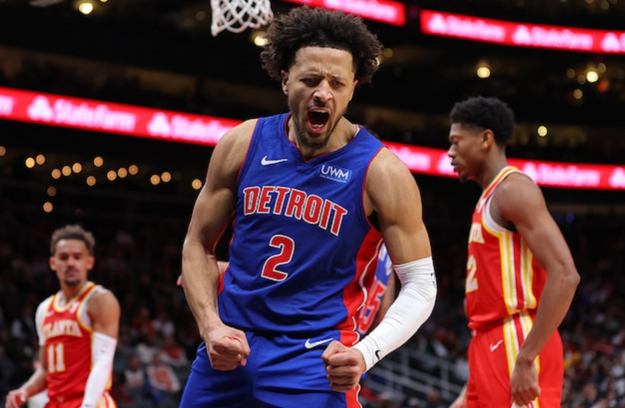
Detroit’s offseason has to answer for one specific collapse. The Pistons won 60 games last season, their first 60-win season in 20 years and their first No. 1 seed in the East since 2006-07, then lost Game 7 of the conference semifinals 125-94 at home to Cleveland on May 17, a blowout in which Cade Cunningham scored just 13 points and went scoreless for most of the second half before getting pulled once the game was decided. That gap, between the best regular season the franchise has produced in two decades and a home elimination that lopsided, is the entire premise behind what Detroit did this summer, and whether it did enough is now a live, public question.
An NBA.com Analyst Is Asking the Question Out Loud
NBA.com’s Shaun Powell put that question in writing on Sept. 9, days before training camp opens. “The competition for the top spot in the East will be stiffer this upcoming season; will the Pistons be able to string together another 60-win effort?” Powell wrote, characterizing Detroit’s roster turnover as closer to a lateral move than a genuine upgrade. That is a notable thing for a league-wide analyst to say about a team that just won 60 games, and it frames the central tension of Detroit’s camp: the front office reshaped the roster around Cunningham without adding a second star to share his playoff workload.
What Detroit Actually Changed
The moves themselves were real, even if Powell isn’t convinced they add up to more talent. Detroit let forward Tobias Harris leave for a two-year, $31 million deal with San Antonio and moved on from Isaiah Stewart, Caris LeVert and Marcus Sasser, then brought in John Collins, Isaiah Joe, Taurean Prince, Gary Harris and Ebuka Okorie, according to The Ringer’s breakdown of the offseason. The stated logic behind those swaps was spacing, not name recognition. Detroit ranked 29th in three-point rate last season despite winning 60 games, and Isaiah Joe in particular, a career 41.5 percent three-point shooter since 2022-23, was brought in as a direct answer to that specific weakness, giving Cunningham more room to operate as a driver rather than adding a shot-creator who could take pressure off him in isolation.
That is the swap at the center of Powell’s skepticism. Detroit spent its offseason making the roster around Cunningham more efficient rather than adding someone who can create his own offense independent of him. If that bet is right, Cunningham should see easier driving lanes and better outside shooting behind him all season. If it’s wrong, Detroit still doesn’t have the second self-sufficient scorer that a deeper playoff run, against a team like the one that just blew them out in Game 7, tends to require.
Cunningham Is not Waiting to Find Out
Cunningham’s own response to that offseason has been to take matters into his own hands before camp even opened. He organized and led a players-run minicamp in San Diego in August, gathering teammates for informal work well ahead of Detroit’s official Sept. 28 media day, according to ESPN’s Dave McMenamin. It’s a voluntary step, not one the coaching staff mandated, and it reads as a direct response to how his own postseason ended: a 64-game season that produced 23.9 points, 5.5 rebounds and 9.9 assists per game and a second straight All-Star selection, followed by a Game 7 in which he managed five second-half minutes of relevance before Detroit’s staff pulled him with the outcome no longer in doubt.
That contrast, an All-Star-caliber regular season and a top-five MVP case undone by one bad night when it mattered most, is exactly what Powell’s skepticism is really about. A 60-win season built on Cunningham playing at an elite level across a 64-game season proved he could be the best player on a very good regular-season team. It didn’t answer whether he can be the best player on a team that wins a second-round series against a team as talented as Cleveland’s backcourt duo of Donovan Mitchell and James Harden. Powell’s framing puts that burden explicitly on Cunningham reaching “MVP level,” not on the roster changes alone.
What Camp Still Has to Settle
None of this gets resolved on paper. Detroit still has an unresolved contract situation with center Jalen Duren heading toward an October deadline, a story NBA Trending has covered separately as it developed, and that uncertainty hangs over camp regardless of how the shooting upgrades play out. What training camp and the preseason will actually test is narrower: whether Joe, Collins and the retooled wing rotation create the spacing Detroit lacked last spring, and whether Cunningham, with a full offseason and a self-organized head start on chemistry, looks different in a second consecutive deep playoff run than he did when the lights went out in Game 7. For the full run-up to opening night league-wide, see NBA Trending’s guide to the 2026-27 season’s key dates .
Two seasons ago, Detroit was a 14-68 team with no real timeline. Now it’s a 60-win team publicly being asked whether it stood still while the rest of the conference got better. Cunningham has already shown he isn’t willing to wait around to find out