
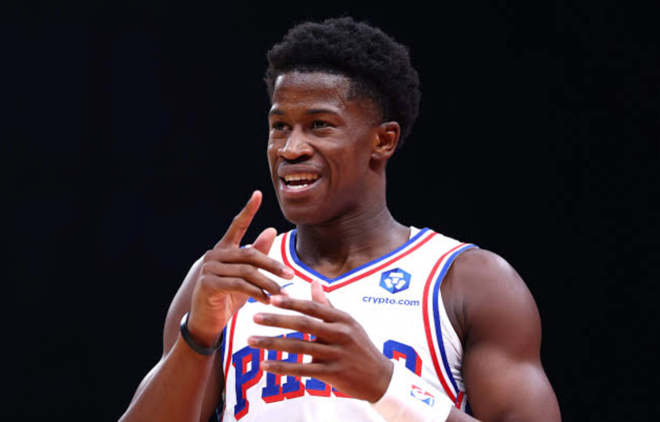
VJ Edgecombe’s Rookie Miracle Now Meets a Crowded Roster
VJ Edgecombe spent his rookie season doing almost everything the Philadelphia 76ers could have hoped for. He started all 75 games he played and averaged 16.0 points, 5.6 rebounds and 4.2 assists as a 20-year-old taken third overall out of Baylor in the 2025 NBA Draft, shooting 43.8 percent from the field and 35.4 percent from three. That was good enough to make him a finalist for the 2025-26 NBA Rookie of the Year award, which Dallas’ Cooper Flagg won over Charlotte’s Kon Knueppel by just 26 points in the voting, with Edgecombe finishing as the third finalist.
None of that guarantees him the same role in year two. Entering the 2026-27 season, Edgecombe’s own locker room got dramatically more crowded. Philadelphia signed LeBron James to a two-year contract in late July, officially ending James’ run with the Los Angeles Lakers, and separately acquired Jaylen Brown from the Boston Celtics in a trade that sent Paul George and draft picks to Boston. Add returning stars Joel Embiid and Tyrese Maxey, and the 76ers now carry four established scoring options into a season where possessions are, by definition, a finite resource.
What Edgecombe Did in the Clutch
The clearest evidence that Edgecombe belongs in the conversation anyway comes from how he played when games were actually on the line. A Sept. 12, 2026 analysis of the Sixers’ late-game offense found that Edgecombe shot 58.7 percent from the field and 54.5 percent from three in clutch situations as a rookie, numbers that outpaced what most rookies, let alone most NBA guards, produce under that kind of pressure. He hit game-winning shots as a 20-year-old on a team that was still figuring out its own identity. That same analysis, though, projected he is unlikely to be featured in isolation-heavy, late-game possessions this season, simply because James, Brown, Maxey and Embiid are all more established options for that specific role.
That is not a demotion so much as a math problem. A team with one clear go-to scorer builds its offense around him by necessity. A team with four, plus a rookie-caliber talent who already proved he can finish, has to actively choose who gets which touches, and in which situations. Edgecombe’s clutch efficiency as a rookie is exactly the kind of individual production that makes that choice harder for Philadelphia’s coaching staff, not easier.
Where He Actually Fits Now
The likely answer is that Edgecombe’s role shifts rather than shrinks. His game as a rookie combined scoring with defensive versatility, the part of his profile that made him a plus contributor even in stretches when his shot wasn’t falling. On a roster suddenly full of proven half-court scorers, that two-way baseline, someone who can guard multiple positions, space the floor as a catch-and-shoot threat, and still punish a switch or a defensive lapse in the clutch, may end up more valuable than a larger shot diet would have been on a thinner roster. If the reported framework holds, and James, Brown and Maxey soak up more of the on-ball creation, Edgecombe’s clearest path to staying central to winning games is doing more of what he already did well as a finisher and less of what he was still developing as a primary weapon.
Edgecombe also spent part of his offseason adding to his resume away from the NBA. On Aug. 31, 2026, he scored 25 points on 7-of-11 three-point shooting to help the Bahamas beat Panama in FIBA World Cup qualifying, extra competitive reps against grown professionals that most 20-year-old NBA players do not get in the middle of an offseason.
What Still Has to Happen
None of this gets settled on paper. Training camps open across the league on Sept. 29, and the actual rotation, who starts, who closes, how Philadelphia’s coaching staff divides clutch-time reps among five players who all have a case for the ball, will only get answered once real practices and preseason games begin. What is already clear is that Edgecombe is not walking into his second season as an afterthought. He is walking in as a Rookie of the Year finalist whose best statistical case, his own clutch shooting, now has to compete for space with three teammates who have combined for a championship, multiple All-Star selections and, in James’ case, a two-decade case as one of the greatest players in NBA history. How Philadelphia’s coaching staff resolves that math will say as much about Edgecombe’s trajectory as anything he does on the court.