
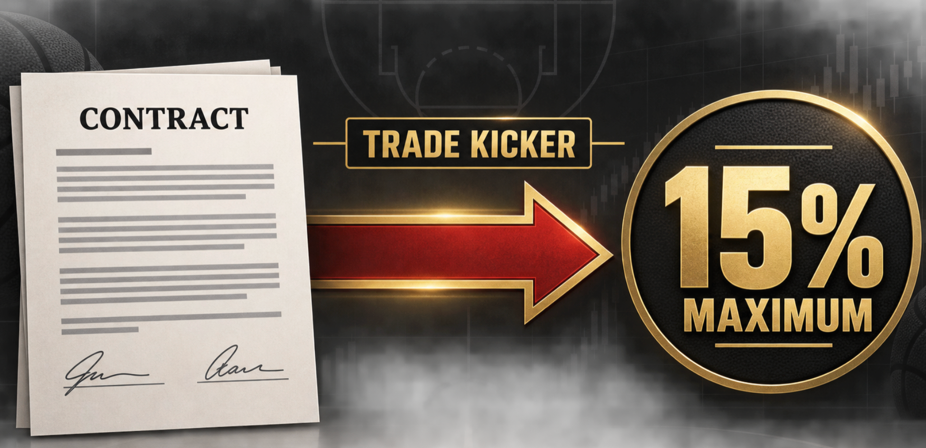
An NBA trade kicker, formally called a trade bonus, is a clause that pays a player extra money the moment he gets traded. It sounds simple, but the mechanics behind it decide whether a rumored trade actually works under the salary cap, and it comes up constantly in offseason and deadline reporting without always being explained. Here is what an NBA trade kicker actually is and how it works.
The 15% Cap: How Big a Trade Kicker Can Actually Be
The NBA’s CBA summary says a trade bonus cannot exceed 15% of the base compensation remaining on the contract when the trade occurs. An unexercised option year is excluded from that calculation. Teams and players can negotiate a kicker anywhere from 0% up to that 15% ceiling, either as a flat dollar figure or as a percentage of the money still owed on the contract. The negotiated percentage can be lower than 15%, and the contract determines whether the clause exists at all.
How the Bonus Gets Spread Across a Contract
For salary-cap accounting, the bonus is allocated across the remaining guaranteed seasons of the contract. The team trading the player is responsible for paying the earned bonus, while the acquiring team must account for the adjusted salary under the applicable trade rules. That means the practical value of a kicker shrinks as a contract gets closer to its end, and it can shift depending on how many guaranteed seasons are actually left when the trade happens partway through a season, since compensation is calculated based on the days remaining in the year.
Trade Kicker vs. Player Option: Not the Same Clause
Trade kickers and player options often get mentioned in the same sentence, since both are common add-ons to modern NBA contracts and both showed up together in Klay Thompson’s Heat deal, but they control completely different things. A player option gives the player, not the team, the choice of whether to play out an additional season of the contract or decline it and become a free agent again; it has nothing to do with being traded and everything to do with when a player’s contract ends. A trade kicker only matters if a trade actually happens, and it pays the player extra money rather than giving him any say over his own free agency. A contract can include one, the other, both or neither, and having both, as Thompson’s deal does, simply means two separate and unrelated clauses are both attached to the same season of the same contract.
The Maximum-Salary Ceiling: Why Some Kickers Get Cut Down
A trade kicker cannot push a player’s salary above his individual maximum allowable salary under the cap. If applying the full bonus would cross that line, the extra money is not simply forfeited outright; instead it is reduced proportionally across the remaining seasons so the total stays at or under the cap. For a player already signed to a true max contract, a 15% trade kicker in that situation is effectively voided rather than paid, since there is no room left under his own maximum to add anything on top of it.
How a Trade Kicker Complicates an Actual Trade
This is where a trade kicker becomes more than a contract footnote. For salary-cap and trade-matching purposes, the bonus counts as incoming salary for the team acquiring the player, but it does not count as outgoing salary for the team sending him away, according to CBA Guide’s breakdown of the rule. That asymmetry can be the difference between a trade fitting under the cap and not fitting at all, particularly for teams operating close to the luxury tax or an apron line. Because of that, players with a trade kicker can waive or reduce it to help a deal go through financially, something front offices routinely ask for when a bonus would otherwise sink the math on a trade. Once a player reduces or waives a kicker, the contract cannot be renegotiated again for six months. The bonus is also strictly a one-time event: if a player with a kicker gets traded again later in the same contract, no second payout is triggered.
A Real Example: Klay Thompson’s Heat Contract
Trade kickers are not just theoretical. When Klay Thompson signed a two-year, $11.5 million contract with the Miami Heat in August 2026 after clearing waivers on a Dallas buyout, that deal included a player option and a 15% trade kicker attached to the second season, according to reporting from The Athletic’s Sam Amick and Darnell Mayberry that was corroborated by ESPN and CBS Sports. In practice, that means if the Heat were to trade Thompson during that second year, the bonus calculation above, the 15% cap, the proration across what is left on the deal, and the maximum-salary ceiling, would all come into play before any other team could complete the deal. It is also exactly the kind of detail that gets glossed over in a quick trade rumor but matters enormously to whether that rumor can actually become a real trade.
Contract mechanics like this show up in offseason and trade-deadline coverage all year, including this month as teams finalize rosters ahead of training camp. For the rest of the calendar leading into the 2026-27 season, see NBA Trending’s guide to the 2026-27 season’s key dates. The next time a trade kicker shows up in a report, this is the page that explains what it actually means for the deal.